
timepiece
on inheriting urgency & the myth of control

There’s nothing more performative than a watch on a girl who can’t tell time. And yet I persist, slogging through the morning rush of Chinatown, on the prowl for a vintage gold watch.
The shop is empty save for the balding Asian man at the counter, who makes an S-shaped arch over miniature screwdrivers. Fumbling together crinkled dollar bills, I gather the courage to practice my creaky Mandarin—barely managing the word for “watch” before he cuts me off in English.
I’m no stranger to American watch stores, once dragged from one Watches of Switzerland to another by an ex-boyfriend in pursuit of some patek-philippe-pipe-dream. Always patiently waiting in the corner, as he angled his wrist like a prize in the fluorescent store light, I’ve picked up some tidbits. Mechanical watches are highly sought after, powered by a mainspring you must wind consistently — feeding time back into the spring lest the seconds go astray. Timekeeping is a labor of love, it seems.
Many vintage watches are still operating today, tiny artifacts that have quietly outlasted their owners. I try on different gold pieces for size, imagining a past life, appointments I would’ve rushed to and fro at the command of this ticking machine.
A gaggle of old Chinese locals enter the scene and Mike of Mike’s Watch enters the cacophony of Cantonese with ease. In the meantime I remain mute, but I extend my hand and allow him to fasten a watch onto my wrist. Staring at the watchface I recall another fact: when the second hand looks smooth, it’s actually ticking furiously — ten microscopic steps per second.
It’s a beautiful thing, this watch, golden framed bezel and faux diamonds that glisten, almost egregiously so. Any watch enjoyer can spot it as a fake, but I tell myself that I just need a quick fix.
Fake watches + fake promises, what’s the difference? These are the lies I like to tell myself, the optimism to believe in college relationships and shiny objects.
Summers carry this false promise, a mirage that glitters in the distance but dulls upon contact. It was last June when I first felt time slow down. Marinating in the humidity like a half-baked rotisserie chicken, awaiting a certain heat-death, I felt restless. It was the summer of ambiguous desire.

The pure lassitude of my remote job left entire days unclaimed. I watched them unspool, and would pack contrived events into blank spaces on my Google Calendar in a helpless sense of agency. Floating in-between the newest cafe to restaurant, collecting badges on my Beli in a pointless quest. In the corner of the latest natural wine bar I collect empty assurances that ennui is par for the course, that this is the age to waste time.
Though I didn’t inherit my dad’s long legs, I got his ticking heart, a nervous tic that makes being on time feel like being late. As a kid I was brought around trips to K-Town, scampering to keep up with him as he charged down Sixth Avenue up. He lectured me with life lessons along the way: how work is a game with winners and losers, how you have to constantly learn that someone else will take your prize, how even when you lose you have to keep going.
He had passed down stories like heirlooms, his favorite being the one of coming to America. 1984 in Shanghai, the first time he heard Country Roads sung by visiting American students. In pursuit of the mountains in the breeze, passing through Angel Island with $100 in his pocket, Mom in his wake. These stories blurred into trials and tribulations – all for us. These are the stories that dictated my childhood dinners, the ones I dodged by shoveling rice down my throat so I can go back to my Priorities in life like calculus homework or paused Stardew Valley games.
One night this summer, Dad stopped by my apartment. He still commuted to New York from Jersey, and after two decades I tried to ignore the visible wear and tear caused by daily commutes on the NJ Transit. He wielded Molly Tea and fried chicken, whileall I had to offer was a paltry orange, but we feasted nonetheless, perched atop hightop chairs to peck at the goods.
The conversation turned to his job. My vision swims when I look at the computer, he admits, idly peeling a clementine over a plate full of bones.
I don’t tell him I’ve spotted prints of his resume lying around our childhood home, or that Mom bemoans his late nights studying for data engineering certifications, trying to switch job before it’s too late. I try to ignore the corporate truths: there’s an invisible ceiling and a fleeting opportunity to break it before it traps you forever.
I can’t keep up with you young folk, he says.
Then, as always, he insisted how proud he is of me, unconsciously pressing wedges of orange into my hands with a forlorn gaze locked into emptiness. My vision swam with guilty tears: these nights he spent studying I wasted with idle hands and recreational play. He treats days with reverence and me with haste; one of us is working for someone and the other is working for nothing in particular. I make a hollow promise to myself, something needs to change. Maybe I need to work harder.
He sighed, and ended his tirade by saying, I’m getting old these days.
You used to say older, why are you saying old now?
Where my dad measures time in urgency, my mom marks her day in relation to us -- she likes to say that time changes after you have children, casting a loving look at me.
When I was young, routines were dictated by an old red calendar, given out by the local Chinese grocery store. Plastered to the kitchen wall as an anchor, it popped with bright red, a place for Mom to diligently document all the swim practices + clarinet lessons + afternoon clubs to shuffle the kids between.
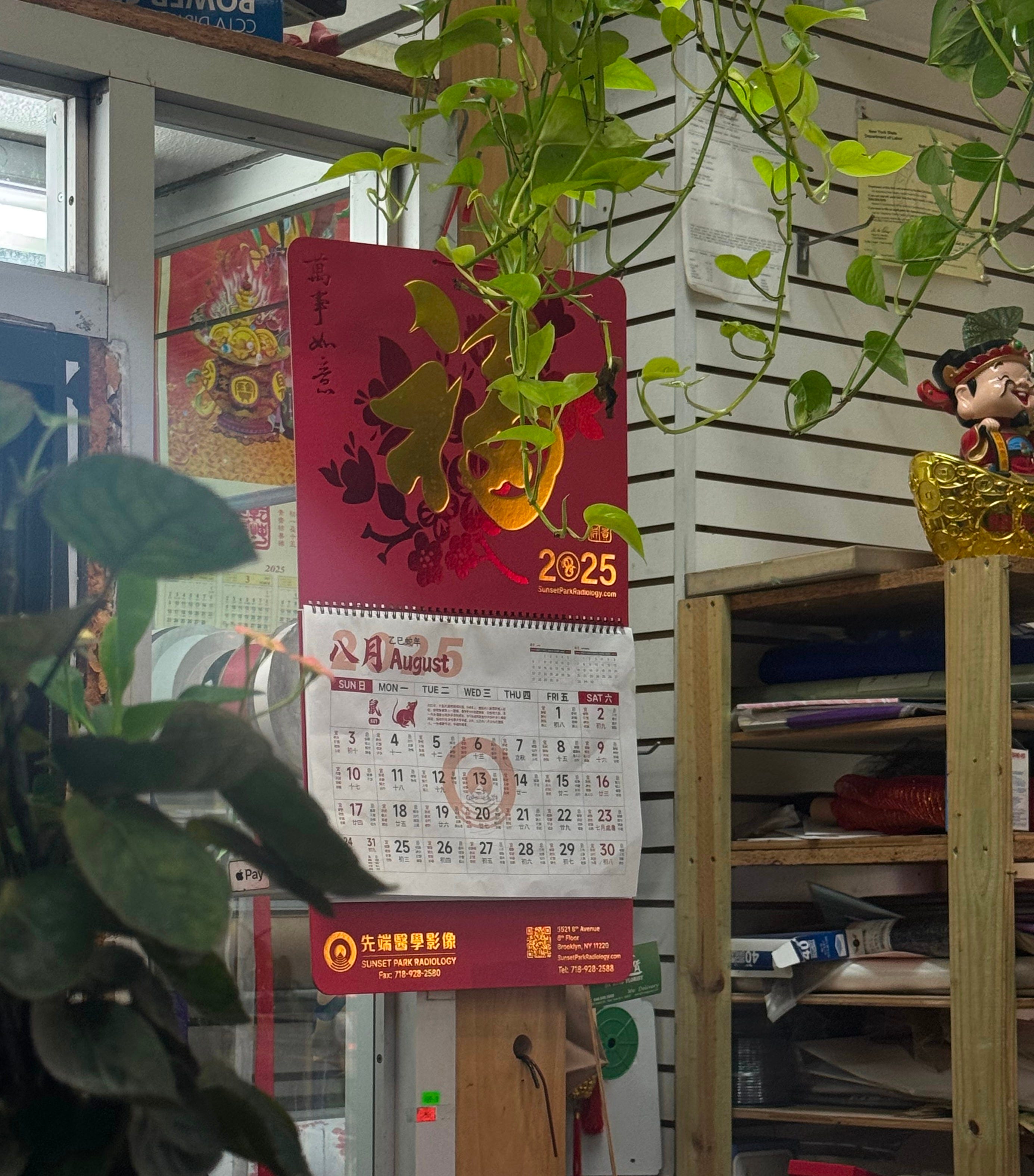
There’s something inexplicably satisfying about the act of unpeeling –- skin separating from flesh –- so when no one was looking I’d tear the page too early, yanking out months with youthful exuberance.
Thin sheets of paper make up a calendar year that meant different things for my parents and me. Time moves slower in times of gravity. When I was ten that one year was 10% of my life, a year that passes through my parents in an instant.
To be a mother is to relinquish your notion of time to something that is outside of you. A child becomes the ultimate timepiece: a biological clock personified, where each accumulated year of age becomes a marker of time for the parents.
To be a child is to realize that the people I love and the ambitions I have are all running on different clocks. I measure what’s ahead as they measure what remains.
There are inflection points I already see fixed in the distance: the year I raise a family, the moment I hit my ceiling at work. I know I’ll meet the same crossroads as my mother, and I’m nowhere ready to relinquish my sense of time to something else.
And so I toil and push this boulder like clockwork. When your father’s boulder stops mid-way -- you can’t help but feel the need to keep it going.
Working out of duty is a Faustian bargain: you labor to support the people you love, at the cost of time to spend time with them. Parents who skip dinners and recitals for last-minute work trips; children who ignore calls and skip out on trips to their hometown, all rationalizing their choices under the guide of ‘duty.’
A child’s sense of time changes with this realization: that as you grow older you will grow further from your parents. These delicate gears and wound-up springs within me, I sense, are starting to drift, the timekeeping going askew.
It’s in these moments that I gravitate towards places that are timeless. There are neighborhoods that demand performance and those that accept you for who you are. I find comfort in the latter, and Chinatown exists as this place where no one cares whether you’re 12 or 24 or 62.
The beauty is that it looks the same no matter the city you’re in. A distinctive visual identity superimposed onto American urban forms, a promise to immigrants: wherever you are, you can look up will always see the sky & upturned pagoda red-roofs & bouyant paper lanterns on twine like arms outstretched at the streets.
本命年, refers to the Zodiac Year you were born in. It comes every twelve years & I’ve always questioned things that come in twelves, dozens of eggs and milk jugs, these arbitrary units of measurement we draw around time.
What a concept, that time is not just linear: it can also return, repeat, revisit, haunt you. In folk belief, that year is often treated less like a victory lap and more like a threshold year when people are extra careful. You could either lose it all or win it all.
My last zodiac year was marked by a quest for gold, specifically fashioned in the likeness of a horse. Mom navigated the jewelry store with ease, schmoozing the shopkeeper. She has a knack for befriending salespeople, having worked in jewelry stores on the Upper East Side in her twenties. Back then, she spent her wages on imitation pieces, dressing herself in fake gold to blend in with the real.
I often wonder what went through the minds of the girls behind the counter — made up like dolls, lips lacquered, wrists heavy with shine — & whether they ever imagined their lives unfolding the way hers did.
It’s February of my next Zodiac year that I take my family to an unfamiliar Chinatown in San Francisco, one that is hilly and littered with debris, where the dim sum carts have been deprecated in favor of ordering live. We take these changes in stride and melt back into routine like memory foam, haggling with vendors for a bounty of assorted kumquats and oranges, searching for the seediest-looking establishment and ordering buckets of congee and soup.
It’s been a year since I first bought my watch. A year marked by empty promises + vacant journal pages + unturned calendar sheets.
I am a chime, and the days move through me like wind.
I cannot stop this constant stopwatch that measures distance from two arbitrary points, an illusion of continuity as I jump from one shiny prize to another. Like a nervous second hand I circle the same question: how does one build a more intimate relationship with time, one that lets you inhabit instead of race against it?
Consider the ancients, and how they survived before our modern-day clocks and watches. Relying on sundials and circadian rhythms. History is threaded with this compulsion to build pyramids and structures that outpace our life times, monuments that define milestones.
We try to contain the inevitable, construct clocks and calendars as artifacts, cursed by this human desire to control time. All we can hope to do is build something that lasts. And such we design our timepieces to outlive us.
& so I persist, a ticking clock that drums like heartbeat.

This piece is inspired by the following:
Jackson Dahl’s interview with Che-Wei Wang & Taylor Levy, artists who design their own temporal artifacts intended to reshape our perspective to time..
Diego Baez’s poem, Inheritance.
Ruth Ozeki’s A Tale for the Time Being
Interstellar, extremely loosely
this is incredible! I grew up in Swiss towns filled with watch stores and a watchmaker uncle and am seeing some of those memories differently now - love how you stitched it all together :)
oh my gosh you wrote the time piece!! what an absolutely joy to read